
Entity Ownership Percentages
Sometimes the "owner" of a property is an entity — an LLC or partnership — that is itself owned by several investors. Account Ownership records let you capture who those investors are and what share each holds, so REDA can split owner statements and expense reconciliations between them. After reading, you'll be able to record the percentage owners behind an account, date-scope those shares as they change over time, and understand the one thing REDA deliberately does not do here: check that your percentages add up to 100. No prior REDA experience is assumed.
Access you'll need. These records sit under Accounts, and access to Accounts is granted by your administrator separately from the REDA permission sets. If you can open and edit the owning account, you can manage its ownership splits — check with your administrator if you can't see them.
When one owner is really several
On paper, a property is owned by one account. But that account might be a holding company that several investors own between them. Account Ownership is where you record that reality: one record per investor, each holding a percentage of the account.
It's worth keeping this distinct from the property's ownership trail, which they're easy to confuse:
Recording an ownership split
From the owning account, add one Account Ownership record for each investor:
| Field | What it's for |
|---|---|
| Parent Account | Required. The account being divided — the entity the investors own between them. |
| Owner Account | Required. The investor holding this share. One investor per record. |
| Ownership Percentage | Required. This investor's share of the account. |
| Ownership Start Date / Ownership End Date | The period this share applies to. Leave the end date blank while the share is current. |
| Comments | Free text — the reason for a change, a reference, whatever you need. |
An account named as an investor here can't be deleted while it's referenced — REDA protects it so a split never loses the investor behind it.
Date-scoping splits over time
Ownership changes, and REDA handles that through the start and end dates rather than by overwriting the old figures. When a stake changes hands, you close the old era and open a new one:
Done this way, the account keeps a clean history: you can see exactly who owned what, and for which period.
What the splits feed
The percentages aren't just for reference — REDA uses them to attribute money to the right investors for the right period. Owner statements, owner draws, and expense reconciliations read the ownership splits to divide amounts between the investors according to their shares over the dates concerned. The mechanics of how a statement or reconciliation is built live in their own guides; here it's enough to know that accurate, well-dated splits are what make that attribution correct.
The clearest place to see this is an owner draw — the periodic pay-out of an owner's available balance. When REDA pays out an account that has ownership splits recorded, it divides the draw by those shares as they stood on the draw date and pays each investor their own portion separately. An investor holding 30% receives 30% of the draw; the remaining 70% goes to the others in proportion. This is why the dates matter as much as the percentages: a split that was open on the draw date is the one that gets used.
What REDA does not check
Worked example: Continental Holdings
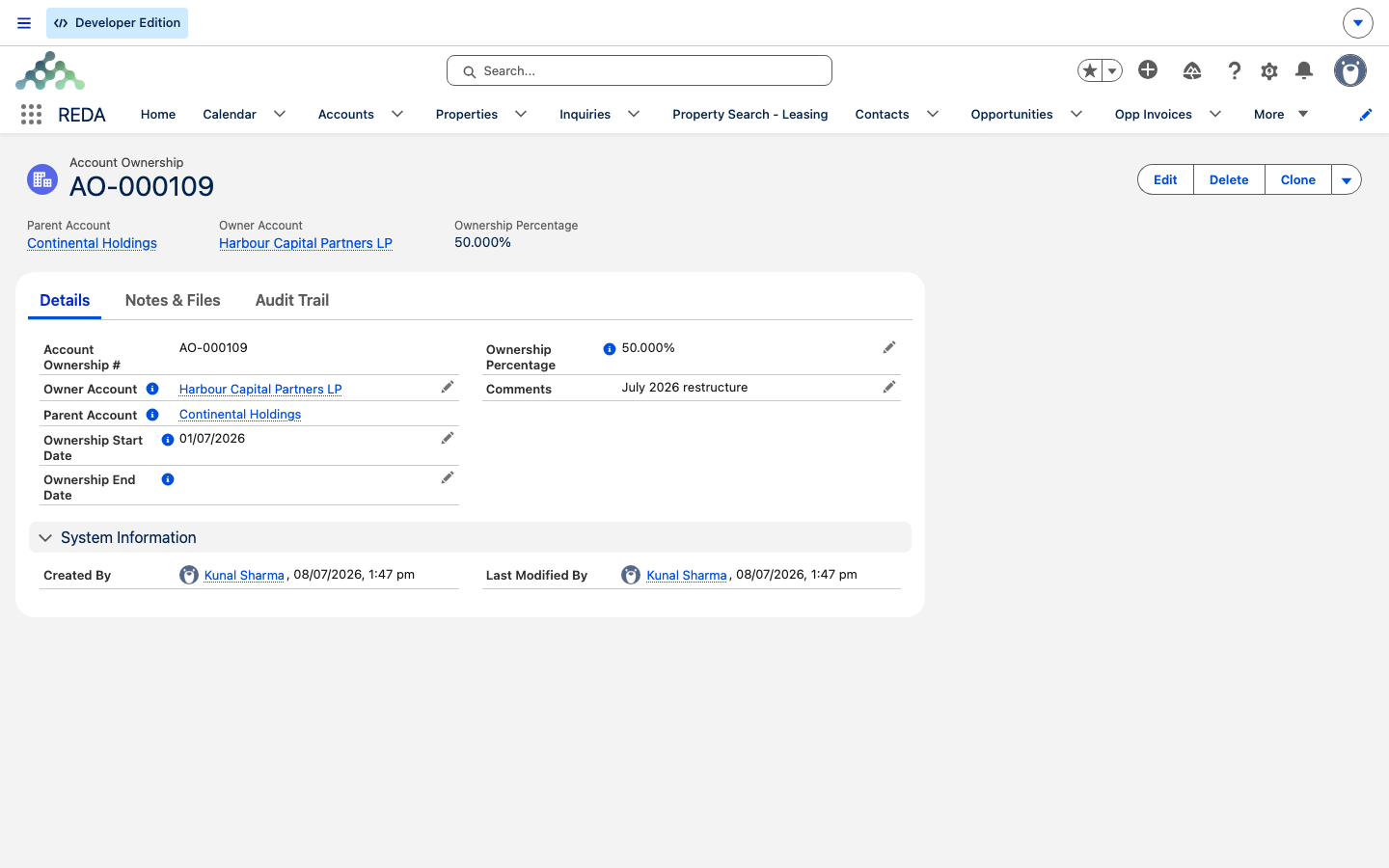
Continental Holdings is owned 60% by the Rahman Family Trust and 40% by Beacon Capital, both from 1 Jan 2026 with no end date. On 1 Jul 2026, Beacon sells half its stake to a new investor, Crest Partners.
| You do | Result |
|---|---|
| Record Rahman Family Trust 60% and Beacon Capital 40%, both starting 1 Jan 2026, end blank | The current split: 60 / 40 |
| End-date Beacon Capital's 40% record at 30 Jun 2026 | Closes Beacon's original era |
| Add Beacon Capital 20% and Crest Partners 20%, both starting 1 Jul 2026, end blank | The new current split: Rahman 60 / Beacon 20 / Crest 20 |
| By mistake, save a set totalling only 90% | REDA saves it without complaint — no total is enforced, so you catch it yourself |
Where to go next
- Portfolios — grouping an investor's holdings for relationship management.
- Property Lists & Tags — hand-picked property groups for reporting and distribution.
- Regions — where currency and the region code that stamps these records come from.
Frequently asked questions
No. Totalling 100% is a convention, not a system check — REDA saves any total. Review your splits yourself, since bad splits produce bad statements.
REDA won't stop you — there's no overlap or ordering check. But overlapping periods double-count an investor in downstream statements, so keep each investor's eras contiguous and non-overlapping.
End-date the outgoing records to the day before the change, then create new records starting on the effective date with a blank end date so they read as current.
An account referenced as an owner on an ownership record is protected from deletion so the split doesn't lose its investor. Remove the reference first if you truly need to delete the account.
The account is treated as owning 100% of itself, so owner statements and draws pay out to that single account with nothing to divide. You only need Account Ownership records when more than one investor sits behind the account and their money has to be kept separate.
No. The ownership trail is the property-to-account history, written automatically. Account Ownership is the investors behind an account, recorded by hand. Different questions, different records.
Was this article helpful?